Meaningful Climate Action

Meaningful Climate Action
Meaningful Societies

Meaningful Climate Action

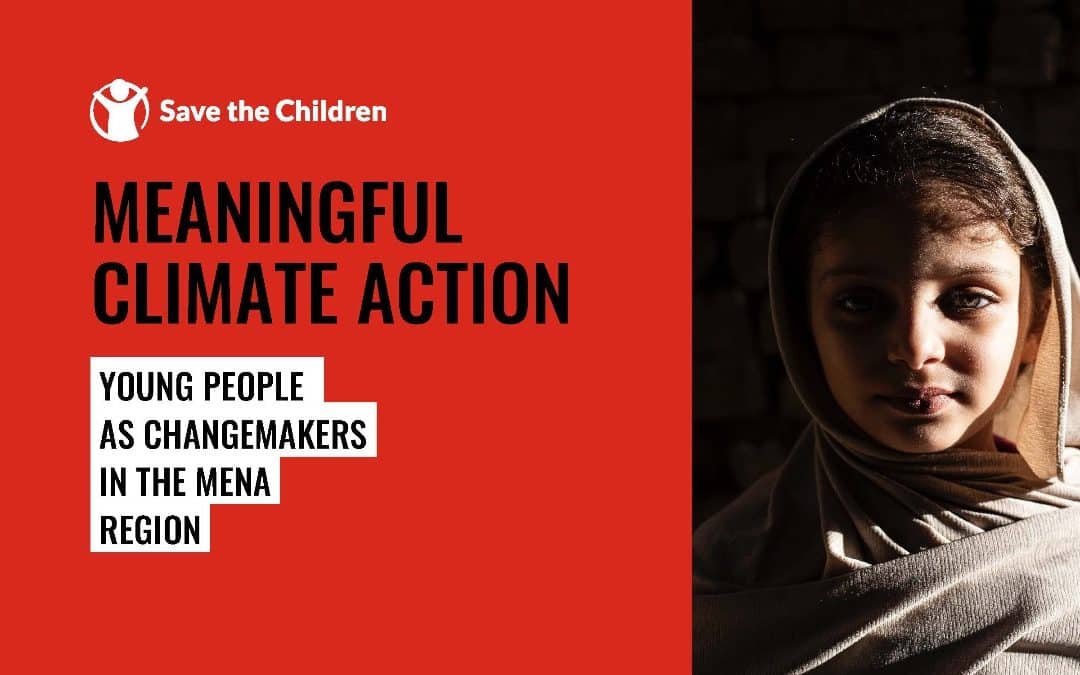
Save the Children Regional Office in the Middle East, North Africa and Eastern Europe – in partnership with the Regional Youth Committee and Voluntas research consultancy – collaborated with children and youth across the MENA region to produce this participatory research study, aiming to map child and youth inclusion in the climate policy landscape in the region, and to identify concrete entry points to make young people’s participation in climate action more meaningful.
Niklas Kabel Pedersen
nkp@voluntas.com

Elisabeth Jones

ejo@voluntas.com

Aya Barouni

aba@voluntas.com

Situation

Climate change poses a significant threat to the Middle East and North Africa (MENA) region, affecting its environmental, economic, and social structures. Recognizing the urgency to address these challenges, there was a critical need to engage and empower the youth, who are pivotal in driving long-term climate action and sustainability.

Challenge

The main challenge was to effectively mobilize young people in the MENA region, a demographic that has historically been underrepresented in policymaking and environmental activism. The goal was to enable them to have a meaningful impact on climate policies and practices within their communities. There was also a need to bridge the gap between young activists and decision-makers, ensuring that the voices of the youth are heard and integrated into tangible climate actions.

Solution

In response, a collaborative project was launched to develop and implement strategies that empower young people as changemakers in the field of climate action. This initiative involved creating platforms for dialogue, capacity building, and advocacy, where young people could learn, share ideas, and influence policy. The project facilitated workshops and forums that brought together youth, policymakers, and environmental experts to co-create sustainable solutions for the region’s pressing climate issues.

The collaboration focused on providing the tools and knowledge necessary for young people to lead impactful climate initiatives, ensuring their active participation in shaping a resilient future for the MENA region. By equipping them with the skills to advocate for environmental justice and sustainability, the project aimed to foster a new generation of environmental leaders.

Follow us on social media
Unlocking Leadership: Novozymes’ Journey to Unlock Growth

Unlocking Leadership: Novozymes’ Journey to Unlock Growth

Client Case

Unlocking Leadership: Novozymes’ Journey to Unlock Growth

Novozymes is on a mission to unlock growth. But how do you preserve the essentials of a thriving culture while nurturing change and transformation to create a profitable business? 

As a company powered by biotech, where nature meets engineering, Novozymes found inspiration for their approach to meaningful leadership in how a flock of birds navigates together toward their destination. 

Nicolai E. E. Iversen

nei@voluntas.com

Ebba Hansen

eha@voluntas.com

Fenja Todte

fto@voluntas.com

Situation

Novozymes, a biotech leader, aimed to preserve its culture while nurturing change to create a profitable business amid rapid industry changes and competitive pressures.

Challenge

The challenge was to translate the new ‘Unlock Growth’ strategy into actionable leadership behaviors that would ensure unity and agility across the organization globally, maintaining core values while driving growth.

Solution

Voluntās and Novozymes developed the ‘Unlocking Leadership’ program, which defined core leadership capabilities necessary for strategy success. The program included data-driven tools like a 360-degree feedback system and leadership training modules, which aligned with the company’s values and growth objectives, ensuring leaders at all levels could execute the strategy effectively.

TRANSFORMING LIFE SCIENCES BY HUMANIZING CULTURE & LEADERSHIP

Meaning in Madness?

Novozymes exists to find biological answers for better lives in a growing world. With increasing populations, fundamental changes in nutritional habits, and protein demands that far exceed the practices of today, the world is screaming for sustainable solutions.

But while Novozymes has become a leader in the industry, the company has for consecutive years struggled to grow in an increasingly competitive market. To beat the trend of some years without growth, the company launched its strategy ‘Unlock Growth’ under the leadership of new CEO Ester Baiget. But to make the strategy move from paper to reality, one particular issue needed to be addressed.  

“As much as we believed in the direction of the strategy, we actually put a dedicated must-win battle into it, that we labeled ‘succeeding with the strategy’,” Marianne Bie Frydendahl explains.


“It may sound redundant or even borderline foolish, but it serves as a constant, tangible reminder to always think about how to execute. And with the number one driver of succeeding with the strategy being a unified leadership, we gave birth to our global program: Unlocking Leadership to Unlock Growth.”

Founded 
2000

Yearly Oxygen 
DKKb 17,553 (2022)

Human beings 
6.527

Purpose 
To find biological answers for better lives in a growing world

THE SOLUTION:

Unlocking Leadership

The first step in the program was to translate the strategy into the core leadership capabilities needed to deliver on the strategy, defining which behavior and attributes from the existing culture to keep and which to evolve.

One core theme across the new leadership framework was unity. 

In Novozymes, we are often inspired by the attributes of rapid animals like cheetahs or falcons. But as leaders of Novozymes, we need to be in formation, in unity, like the birds who fly side-by-side in the hundreds or thousands. 

It is fascinating how they can constantly change shape and direction without becoming apart. By flying together, they can fly longer. Science tells us that every bird is attentive not only to its neighbours in the flock but also to the 6-7 birds around them – some close, some far away. In many ways, they think end-to-end, they think holistically, they think as one enterprise. In Novozymes, we are privileged by having good leaders. But we needed to support them to succeed as one, in flying even closer together,” Marianne Bie Frydendahl.

“As much as we believed in the direction of the strategy, we actually put a dedicated must-win battle into it, that we labelled ‘succeeding with the strategy”

Marianne Bie Frydendahl
Vice President, People & Organization

In collaboration with Voluntās, each leadership capability was broken down into globally aligned, measurable behavior so that three distinct traits accompanied each of the four capabilities (See purple box below). As such, the capabilities outlined the specific criteria every leader, from CEO to team leader, from all functions and markets, should navigate by to contribute to better unity. 

“We are not changing our purpose. We do not compromise our values or our sustainability pledge. But we need to constantly stay in formation, change shape and direction together when needed to protect our core and translate our purpose into growth in our top line. This agility requires four leadership capabilities that we all share and aspire to live up to. Together, they define what good leadership looks like for us – to unlock growth,” Marianne Bie Frydendahl.

A GLOBAL SUCCES

So far

But with limited time and resources, how do you make all leaders relate to the same leadership capabilities at more or less the same time in a meaningful manner? The recipe for Novozymes consisted of four elements. 

First, make it simple and tangible. Unlocking Leadership was tied closely to existing concepts, making it clear how it is a natural lever for the already known strategy and a leadership-specific extension of the organizational values. 

Second, “toolify” it. “Unlocking Leadership” was translated into a data-driven 360-degree feedback tool, a revised template for the Individual Development Plan, and specific training modules targeting each leadership capability. 

Third, focus on facilitating meaningful conversations between human beings. Not trying to control every single outcome with rigorous supervision but instead giving leaders the means and inspiration to have good, genuine conversations, weaving the thriving and self-awareness of the individual into the needs and development of the organization. And then trusting them to apply the global framework locally how it makes sense to their context and team. 

Over the course of a year, 583 leaders at Novozymes have received 360-degree feedback through “Unlocking Leadership,” with 95 percent receiving in-person feedback on the insights. 82 percent perceived it as meaningful and valuable, and 73 percent anchored specific learnings into development plans. 

“It works, because it is concrete”, Marianne Bie Frydendahl explains. “It tells us what we need to do, using fewer words and leaving little room for confusion, creating a common language for good leadership and a few impactful tools to support it,” Marianne Bie Frydendahl.

And fourth? Humor. Using a bit of irony generates smiles and laughter, fostering a sense of belonging and humanness. “We expect a lot from our leaders. They need to be good people managers, be on top of their function, and navigate the many changes we are making in a competing business landscape, while coping with the uncertainty of an incoming merger. So, when we introduce new global initiatives, we need to be incredibly mindful of balancing the need for unity with respect for the individual context. We are all human, so we decided to create a small sit-com-like film, where we exposed all the worst-practice examples of how not to conduct development conversations to make it more fun and engaging and less corporate,” Marianne Bie Frydendahl.

INDIVIDUAL DEVELOPMENT PLANS

Movie to launch individual development plans

While Voluntās were responsible for the directing, filming, and editing, the movie consisted of Novozymes staff as actors giving a human touch to an essential topic. 

Scenes, characters, and punchlines were later repurposed as GIFs and images to serve as a reminder to prioritize meaningful conversations. Knowing that in this year’s Meaningfulness at Work report, the lowest scoring item globally was “my leader takes time to ask how I am doing both professionally and personally, and I feel that he/she listens and takes action,” then nothing is more important to improve our sense of meaning and belonging in the workplace than exactly that. 

In the words of Marianne Bie Frydendahl, “A thriving business needs a thriving organization and vice versa. While we are far from perfect, I am proud of what we have achieved with Unlocking Leadership and how our leaders across the globe have used it to drive change and follow through, all while leading for purpose and with a human touch. It shows that it is here to stay.” 

Forwarding Organizational DNA: Sustaining Culture Amidst Rapid Growth

Forwarding Organizational DNA: Sustaining Culture Amidst Rapid Growth

Client Case

Forwarding Organizational DNA: Sustaining Culture Amidst Rapid Growth

Scan Global Logistics (SGL) has successfully preserved its organizational DNA and fostered a culture of meaningfulness even amidst substantial growth.

But it takes continued priority, consistency, and processes to keep forwarding the organization’s unique DNA to new recruits, new acquisitions, new leaders, and the organization at large. 

Nicolai E. E. Iversen

nei@voluntas.com

Constanca Pinto Moura

cpm@voluntas.com

Juraj Kiljon Hanke

jkh@voluntas.com

Situation

Scan Global Logistics (SGL) experienced rapid expansion, growing its workforce by nearly 200% and increasing annual revenue significantly. This growth presented challenges in maintaining its unique organizational culture.

Challenge

The primary challenge was preserving the foundational DNA of SGL—characterized by fun, integrity, respect, and entrepreneurship—despite rapid scaling, global expansion, and integrating multiple acquisitions annually.

Solution

Voluntās helped SGL implement a robust cultural due diligence process that included scrutinizing every step of the employee journey. This approach ensured that new hires and leadership aligned with SGL’s core values. The use of data-driven tools and regular leadership assessments enabled SGL to continuously promote and reinforce its culture, achieving a high Meaningful Work Quotient (MWQ) score and retaining a positive organizational environment.

FROM A WRINKLED PIECE OF PAPER TO REALITY:

Making culture a little less complicated

It’s been almost five years since the executive management team sat around a table, each taking turns expressing why they work at SGL and what makes the culture unique.

It was the first of many discussions, trying to grasp the essence of the rapidly growing forwarder. They knew that what they were part of was special. But they did not know exactly how to express it. More colleagues from across the globe joined the conversation. Customers and suppliers were invited to give their honest feedback. And then, during a leadership workshop in rural parts of Denmark, a wrinkled piece of paper was circulated. “We make the world a little less complicated,” it read. That is why SGL exists. But how? By always bringing a human approach to everyone, everywhere. An approach that, in the weeks and months that followed, was captured in Fun, Integrity, Respect, and, not least, Entrepreneurship. 

Easier said than done, of course. But fast forward to 2023, and SGL has expanded its workforce by almost 200 percent, achieved an annual average revenue growth of 33 percent to reach USD 3,506 billion, with a presence in more than 45 countries across all inhabited continents. What was an anticipated future became reality – and then some! Adding the impact of a global pandemic and the integration of 5-7 acquisitions per year, you would think that the organizational culture would suffer. 

Globally, as documented by Voluntās, work in the world outside SGL became significantly less meaningful. The logistics industry, in particular, had a hard time with disrupted supply chains trying to catch up with inflated demand. But in SGL, something different happened.

During 2020 and 2021, SGL not only improved their MWQ score from 75 to 77 but also stayed an impressive 15 percent above the global logistics benchmark. While that seemed almost too good to be true, 2022 resulted in the highest Meaningful Work Quotient (MWQ) ever documented for a company of its size, with SGL further improving by 3 percent, reaching a total score of 80.

“We’ve always had a clear intuition that SGL is a meaningful place to work,” Mads Drejer, Global COO & CCO, explains.

“But being clear on our DNA has enabled us to be even better at promoting the right behavior, attracting the right people, and anchoring who we strive to be in all corners and processes of the company. This is a continuous journey that never ends, and while we remain our biggest skeptics, we will try our best to create a meaningful culture and constantly develop the right tools and structures to remind us about who we want to become.”

Founded
1975

Yearly Oxygen 
USDb 3,506 (2022)

Human beings

3.500

Purpose 
Making the world a little less complicated

CULTURAL DUE DILIGENCE: 

Scrutinizing every step of the employee journey

According to Mads Drejer, structure and tools are essential in scaling a culture during extreme growth. Getting data-driven insights into how meaningful it is to work for SGL is one thing.

But SGL went further to look at every single step of the employee journey and examine how each step, each process, could be tweaked to amplify the right culture. Starting with the leaders, SGL’s DNA was translated into tangible behavior for all leaders to get recurring feedback on their performance according to the company’s four virtues. The results were clear. The leaders performing well in their 360-degree leadership assessments also had a 53 percent higher MWQ-score in their teams and a 23 percent better performance on retention.

SGL then focused on their recruitment process and started assessing all potential candidates for leadership positions on their self-awareness and cultural fit to SGL. Finally, SGL has installed a strong focus on culture into the due diligence process for all potential M&A targets.

“We don’t expect our leaders to be perfect, but they need to be motivated to create a meaningful workplace”

Mads Drejer
Global COO & CCO

“SGL runs on the energy of good people. When they grow, we grow. This is where our organic growth comes from, and it is what unlocks the synergies and multiplier effect in our acquired growth. We don’t expect our leaders to be perfect, but they need to be motivated to create a meaningful workplace. This starts already before we let people in through our doors. Whether through recruitment or acquisition, we have invested in a rigorous process, conducting a cultural due diligence on every individual and M&A target to qualify how they fit into our DNA and culture. Culture might have an appetite for strategy, but nothing eats culture like poor leadership, and we will never realize our commercial potential without the right leaders who share our visions and virtues,” Mads Drejer, Global COO & CCO.

VISION 1-3-5:

Towards 2027 

ast year, SGL launched its Vision 2027. 170 leaders from across the globe were gathered in the middle of a forest for a three-day festival to kick it off. Labeled 1-3-5, it aims to unite SGL’s cultural DNA with its commercial ambitions. ‘1’ points to the aspiration of becoming the most purpose-driven and meaningful company in the logistics industry. For SGL, culture and business are fundamentally viewed as one and the same from the core belief that by growing its people, it grows its business. ‘3’ points to the aspiration of reaching the best 3rd in the logistics industry on earnings.

For SGL to realize its potential, earnings function as financial oxygen to ensure a strong and sustainable business with the appropriate attention and discipline to maximize value. ‘5’ points to the aspiration of achieving a total USD +5 billion in revenue. The rationale, according to SGL, is that the more it grows in size and footprint, the bigger an impact it can have on the world to uncomplicate logistics. In the spring of 2023, SGL welcomed CVC Capital Partners as new majority owners as part of entering the next phase of the company’s growth. 

“As much as we enjoy the prospect of making SGL a success in financial terms, that would be worth absolutely nothing to us if it was not achieved while having fun along the way,

paying respect to the people who work hard every day, being entrepreneurial in the market and having the integrity

with us to be able to look ourselves in the mirror and be proud of what we do. We are now a USD 3bn company,

but without continuously mastering our DNA and human approach, our ‘1’, we will never achieve ‘3’ or ‘5’. With new

owners on board and armed with humbleness, we remain committed to becoming the most purpose-driven and meaningful company in the logistics industry. 

One shipment at a time,” Mads Drejer, Global COO 

& CCO.

From Managing to Mastering Stress

From Managing to Mastering Stress

3
Product offering

From Managing to Mastering Stress

Netti Fuglesang

nfu@voluntas.com

Rasmus Hjalgrim

rhj@voluntas.com
The paradox of stress management  

Maybe you as an individual or organization find tackling stress akin to the Sisyphean myth, where putting a lot of effort and time merely leads you back to the beginning or even to a worse state. Then (unfortunately) you are not alone. 

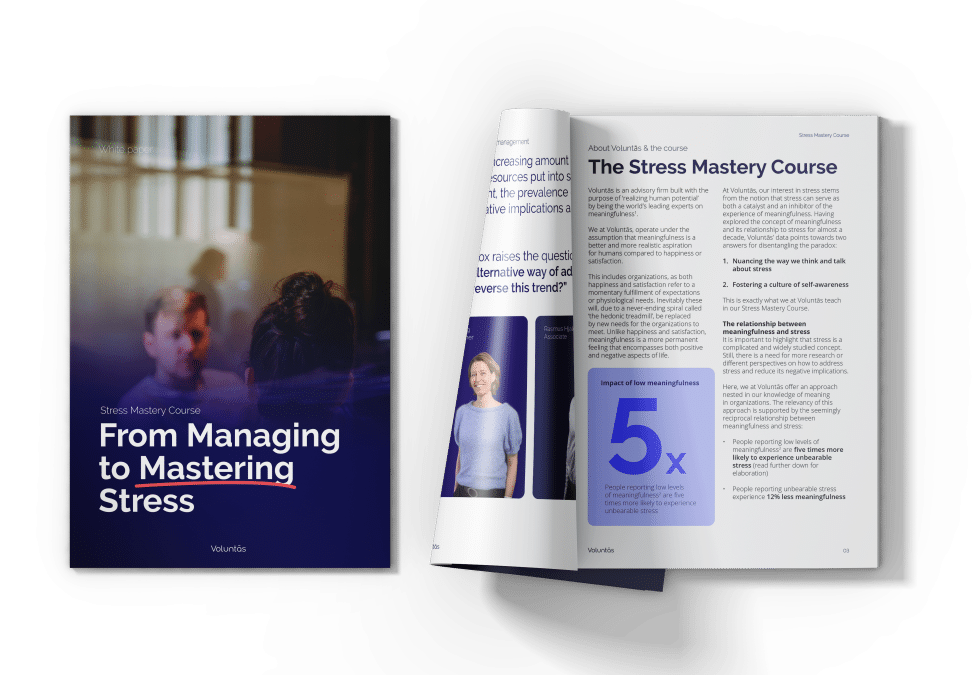
Despite an increasing amount of focus and resources put into stress management, the prevalence of stress and its negative implications appear to keep rising. This paradox raises the question: “Is there an alternative way of addressing stress to reverse this trend?”  

Having now surveyed more than 50,000 employees and leaders across several industries and countries on how they experience meaning at work and explored the concept of meaningfulness and its relationship to stress for almost a decade, Voluntās’ data points towards two answers: 

  • We need to nuance the way we think and talk about stress   
  • We need to foster a culture of self-awareness    

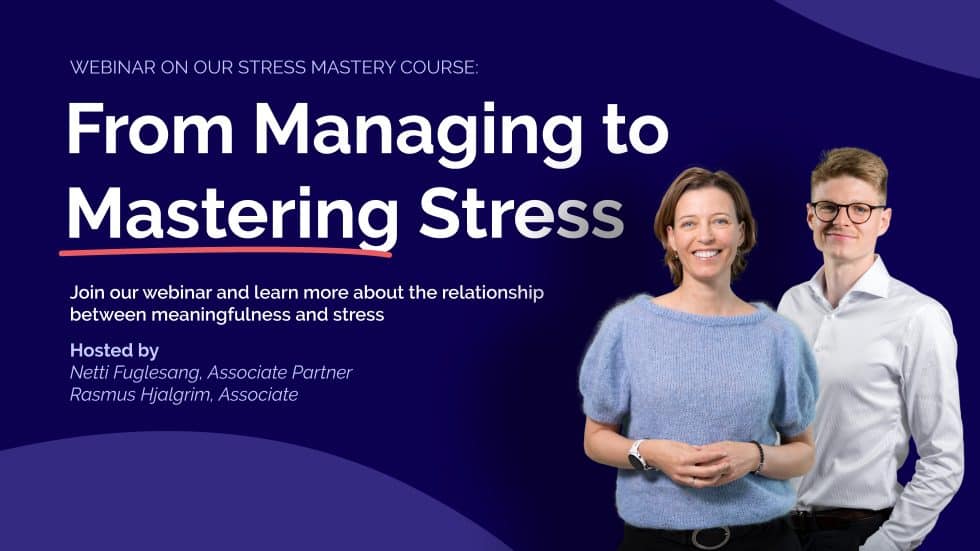
This is exactly what we at Voluntās teach in our Stress Mastery Course and what we will dwell upon in our upcoming webinar. 

Equipping employees, leaders, and organizations with a nuanced understanding of what stress is to them and how to master it through self-awareness.

Webinar

Unlock the first step towards stress mastery by watching our introductory webinar.

This engaging session offers a glimpse into the essence of the Stress Mastery Course, highlighting the pivotal role of meaningfulness and self-awareness in becoming better at tackling stress.

THE PARADOX

The complexity of tackling stress 

When organizations today are called upon to tackle stress, they face an overwhelming challenge as it is, firstly, difficult knowing where even to begin, and, secondly, stress has become a victim of mainstream and uninformed notions about the concept. This situation leaves organizations vulnerable, and they end up going for a stress management strategy that is either too broad or too narrow, too collectively or individually oriented, and, more importantly, not tailored to their specific culture. 

To back this up, although people are inclined to regard stress as something bad that should be avoided, stress is an inevitable part of the culture in some of the most meaningful organizations we at Voluntās have worked with. Yet, the reverse also holds true in that: 

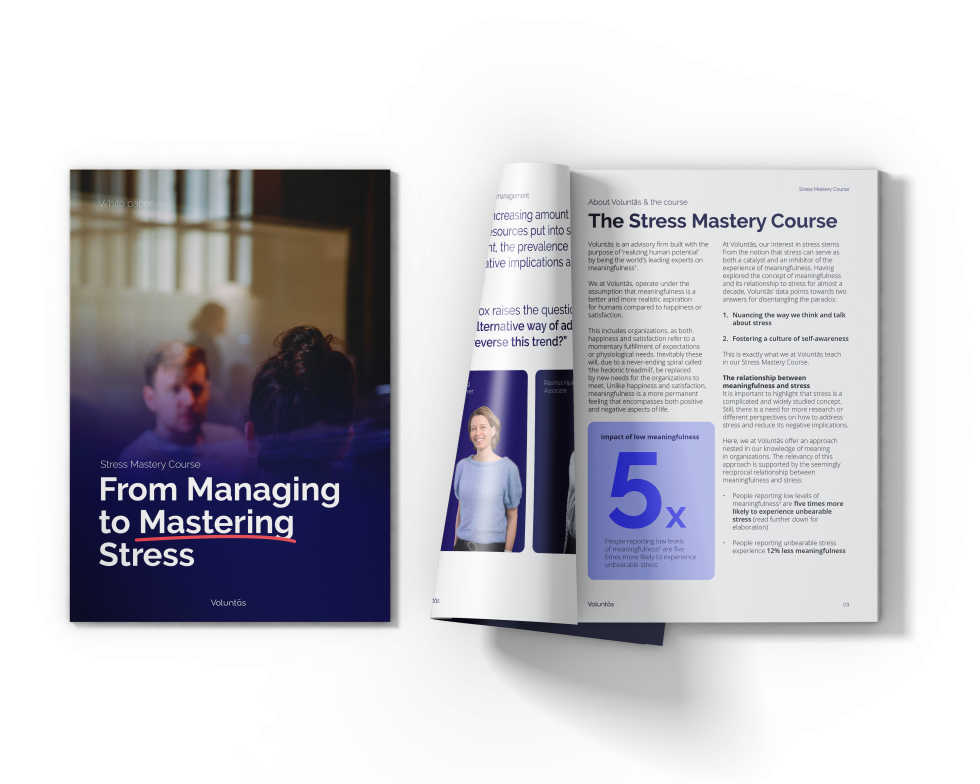
  • People reporting low levels of meaningfulness are five times more likely to experience unbearable stress 
  • People reporting unbearable stress experience 12% less meaningfulness 

MEANINGFUL LEARNINGS FROM THE WEBINAR

(Self)-Assess what is needed

Understanding what role stress plays in your organizational culture, your everyday life and how you should approach it requires the ability to look inward and self-assess your needs, capabilities, and limitations. Yet, this is easier said than done as we are constantly impacted by activities and psychological mechanisms that lead us away from the path towards self-awareness and instead compromise our health and social needs, worrying unnecessarily and, ultimately, becoming unbearably stressed. 

Many of these mechanisms and instances of unbearable stress are preventable, especially with help from other people, but organizations often lack the knowledge and skills to nurture an environment where this is possible. 

Download white paper

Learn why we at Voluntās find it essential for individuals and organizations alike to change the way they think and talk about stress and to foster self-awareness if they want to tackle the paradox of stress management: The prevalence and negative implications of stress appear to rise despite increasing efforts to manage it.

Having participated in the webinar, you will have insight into: 

  • What stress is and what it is not and its relationship to the experience of meaningfulness 
  • The damaging effects of too much and too little stress 
  • The importance of striving for the perfect (im)balance between stress and recovery 
  • Psychological mechanisms that cause unbearable stress and how to combat these 
  • Practical tools for mastering stress at an individual, team, and organizational level 

If you find any of the above interesting and relevant, we strongly encourage you to sign up for the webinar and download our white paper. The white paper elaborates on the paradox of stress management and the concepts of stress, unbearable stress, and self-awareness from a philosophical and scientific standpoint. 

We look forward to seeing you. 

TAILOR-MADE TO YOUR ORGANIZATION

About the course

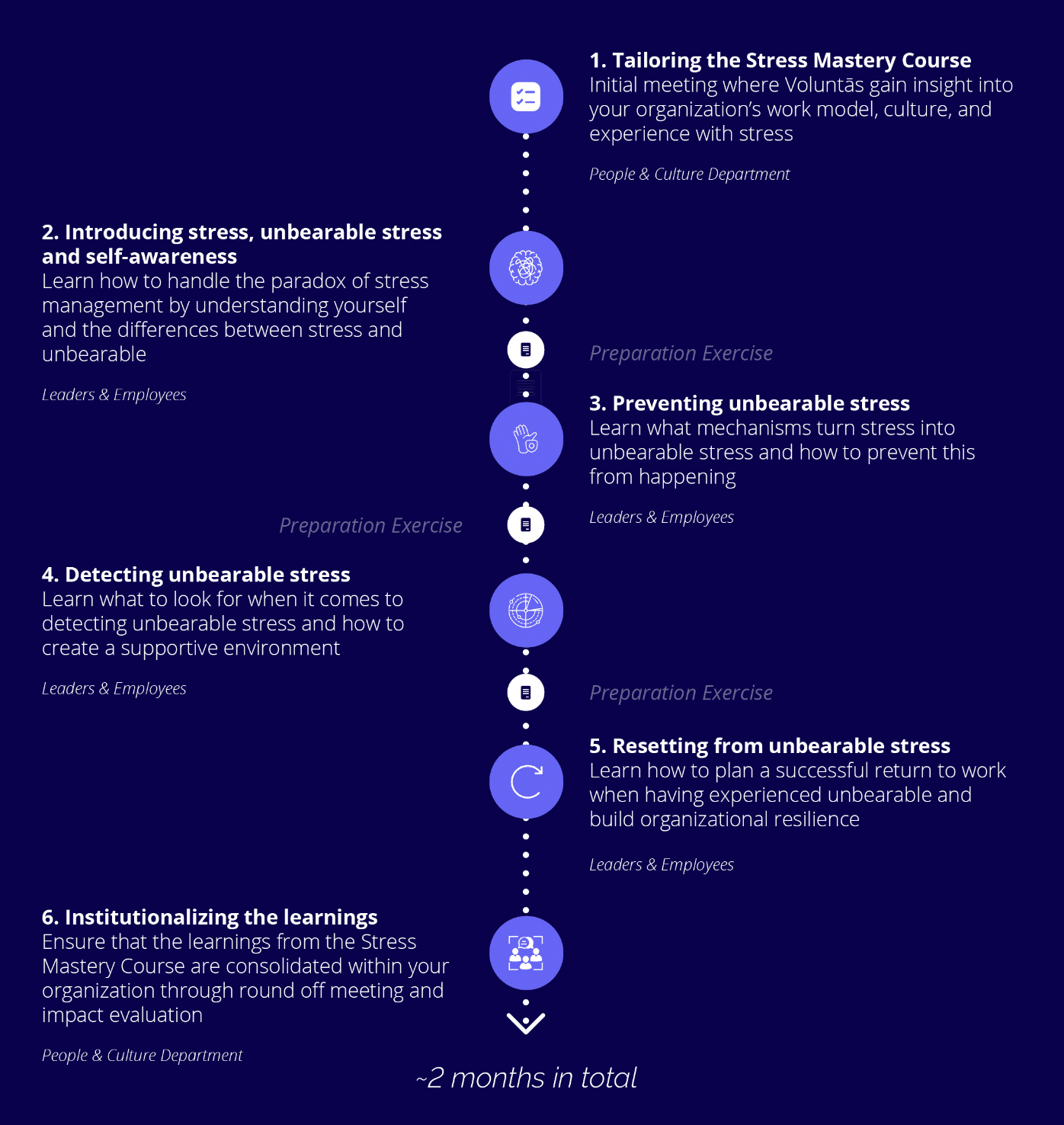
The Stress Mastery Course teaches employees, leaders, and organizations how to nuance and optimize the discourse around stress and foster a self-aware culture. 

The Stress Mastery Course consists of six parts, and the content is tailor-made to your organization’s specific context. 

The participants receive exercises between and after the workshops to ensure the implementation of the learnings.

Netti Fuglesang

Associate Partner & Head of Voluntās Norway

Rasmis Hjalgrim

Associate

Follow us on social media
How to create a meaningful place to work during extreme growth?

How to create a meaningful place to work during extreme growth?

Client Case

How to create a meaningful place to work during extreme growth?

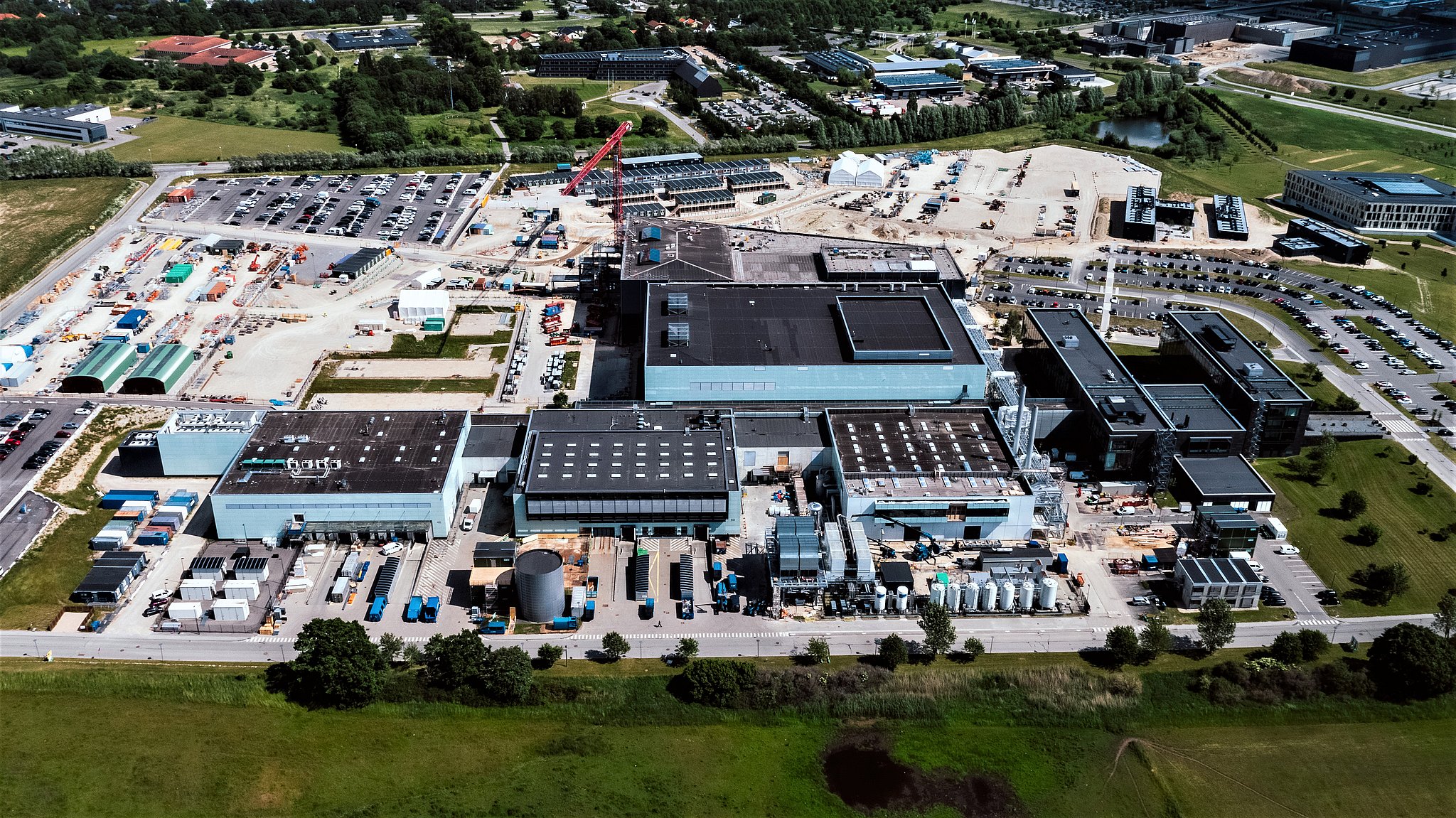
Fujifilm Diosynth Biotechnologies (FDB), a subsidiary of Fujifilm, and a global contract manufacturer in the life sciences sector, is undergoing a multifold transformation. Challenging the norms of the industry, FDB wants to demonstrate that the best way to control their rapid expansion is not by installing rigorous systems, it is by installing trust between humans.

Nicolai E. E. Iversen

nei@voluntas.com

Ebba Hansen

eha@voluntas.com

Carl Emil Zacho Böye

czb@voluntas.com

Situation

Fujifilm Diosynth Biotechnologies (FDB), a global leader in contract manufacturing for the life sciences sector, is undergoing significant transformation. Led by CEO Lars Petersen, FDB aims to redefine industry standards by emphasizing human-centric culture and leadership rather than relying solely on traditional rigorous systems and processes.

Challenge

FDB faces the complex challenge of scaling its operations and revenue significantly while maintaining a meaningful and empowering work culture. The company aims to quintuple its revenue from $1.3 billion to $5 billion by 2030, an ambitious goal that necessitates massive operational and cultural shifts. The primary challenge lies in balancing rapid growth with fostering a workplace environment that prioritizes trust, transparency, and psychological safety, moving away from traditional hierarchical and process-heavy management styles.

Solution

FDB has adopted a revolutionary approach by embedding trust and human sensibility at the core of its operations. The company has eliminated extensive systems and bureaucratic processes, instead promoting a culture where employees are empowered and trusted. This philosophy is encapsulated in their “People Fundamentals,” which guide behavior and interactions within the organization. Leadership development at FDB focuses on emotional intelligence, active listening, and fostering a strong sense of purpose and belonging among employees. This transformation is supported by substantial training programs and events dedicated to cultivating trust and open dialogue among leaders. This shift aims to create a sustainable balance between growth and maintaining a meaningful work environment, ultimately positioning FDB as a trusted partner in the life sciences industry.

TRANSFORMING LIFE SCIENCES BY HUMANIZING CULTURE & LEADERSHIP

Meaning in Madness?

Manufacturing with a Purpose

From DNA sequencing to the final medication product packaged and delivered into the hands of patients, FDB is an end-to-end contract drug manufacturer. From early stage to large-scale production, they support the full lifecycle of biologics development by scaling the manufacturing process. As this year’s Meaningfulness at Work study revealed, both manufacturing (72) and pharmaceuticals (71) are industries facing challenges in meaningfulness at work, scoring below the average (74).

With FDB being an end-to-end manufacturer of pharmaceuticals, they find themselves in a placewhere they need to make an extra effort to create meaningfulness at work among employees. According to President & CEO Lars Petersen, the purpose potential is clear:

“What especially gets me up in the morning is the transformation I believe is so fundamental. I actually do believe that we are a big part of transforming the entire industry where the cost of drugs needs to be lower and where the speed of getting drugs to patients needs to be faster. This requires that we move beyond a contractual, transactional model and instead prove ourselves as a trusted partner to our customers, becoming an integral part of the ecosystem. A partner for life with unprecedented delivery.”

Founded
1923

Yearly Oxygen
USDb 1.3 (2023)

Human beings
4.400

Vision
To be the leading and most trusted global Contract Development and Manufacturing Organization in the biopharmaceutical industry.

SCALING CULTURE

Being A ‘People First’ Company

In the midst of an $8 billion investment plan, FDB is aiming to quadrupling their revenue by 2030 – from 6 large-scale bioreactors to 36. In a world that is renowned for process engineering, tight controlling, and clear chains of command, it would naturally also permeate the governance, organization, and culture of the company. Meticulously cascading targets. Calibrating bonuses with individual performance reviews. Documenting standard decision-making processes. Instead, FDB has made a conscious effort to get rid of all such measures to pave the way for limitless trust, empowerment, and ownership.

“We are trying to keep systems and processes to an efficient minimum to make sure people are the center in everything we do,” Lars Petersen explains.

“Some say that we are building a ‘hippie’ culture. But this is simply about creating a culture of trust, where transparency, being yourself and having psychological safety enables people to speak up at any given moment and be okay with making mistakes as long as we learn from them. Being in a way where people can take ownership, because you know you are trusted and empowered if you do so.”

While production processes and quality assurance as a drug manufacturer is naturally managed with extreme rigor, the underlying assumption is that the human potential of the organization – the people – is best realized by systematically minimizing processes, rules, and bureaucracy.

This philosophy is written into 9 People Fundamentals, which sets the tone and direction for how everyone is expected to show up, interact, and lead. “We lead people – and manage processes”, as one of them reads, continued by “We bring our full selves to work”. The People Fundamentals, however, are not implemented through an extensive roadmap or follow-up system. There are activities and tools, yes, but the primary objective is to create a continuous conversation and mindset around how the right growth can be balanced with the right culture.

Not as opposites, as either-or, but constantly weaving them together to never settle for the ordinary, allowing a touch of madness in pursuing something unprecedented, but without decaying into chaos or anarchy. Always balancing the meaningful and the meaningless.

REIMAGINING LEADERSHIP

Followership above Force

This balancing act requires training. Training in some of the muscles that are often overlooked or under-stimulated in the traditional leadership gym. When the philosophy is about trust, ownership, and empowerment, the mastery required rhymes more with active listening, human sensibility, and emotional intelligence than any other managerial disciplines. To create meaning for people in their work, leadership in itself is the least important driver. In other words, it is not how you as an individual leader perform that creates a meaningful working environment – it is how you as a leader can facilitate a strong sense of purpose, belonging, and personal growth. This, however, breaks with some of the truths many leaders who come to FDB are born and raised to believe in.

“Don’t come in here with the typical mindset of a leader saying, ‘I will deliver in 100 days.’ Forget about delivery. Try to relate to people, try to understand the culture before you even think about delivering anything. And to be honest, eight out of ten of our leaders are going through quite a journey to reconfigure. We even have leaders saying that they had to be broken down completely and rebuilt before they really understood what was going on. We invest that much in our journey, and we are fully aware that this might not be for everyone,” Lars Petersen says.

“We try to deconstruct some of these myths and false truths about leadership to champion a culture where leaders serve not just the business objectives but the human spirit in the organization. This sometimes also entails eradicating inflated egos to foster an environment of true team spirit as opposed to solo climbing the career ladder.”

To manifest this focus, FDB in February brought together more than 100 leaders from across the globe. The full event was dedicated to talking exclusively about strategy, leadership, and culture – not least which habits, norms, or systems the leadership community needs to say goodbye to in order to take the next quantum leap.

“We spent 75% of our time discussing our cultural DNA and how to cultivate trust among our leaders and teams. We asked our leaders upfront to submit all their hopes and concerns to facilitate an open dialogue about what excites us about our growth journey, but also what makes us worried. This is fundamental to build trust,” Petersen shares.

Did the leaders then embrace this focus? Or did they leave thinking it was a complete waste of time? Looking at the impact, the numbers tell a quite convincing story. After the event, FDB were able to track an improvement of 9% in how much the leaders believe in the strategic direction with both their hearts and minds, while improving the level of optimism around FDB’s future by 10% – shortterm as well as long-term. Further, the level of trust in the organization at large increased by 8%. The event itself was rated 9.17 on a 10-point scale – a testament to the appreciation of having time to reflect and connect on how to humanize the culture and leadership.

Nine People Fundamentals at Fujifilm Diosynth Biotechnologies

We foster psychological safety

We bring our full selves to work

We seek attitude when we hire & promote

We assume trust & expect ownership

We value teams over hierarchy

We support individual growth through empowerment

We lead people & manage processes

We lead through purpose & meaning

We lead for the future